
Understanding water wells in Anderson Valley
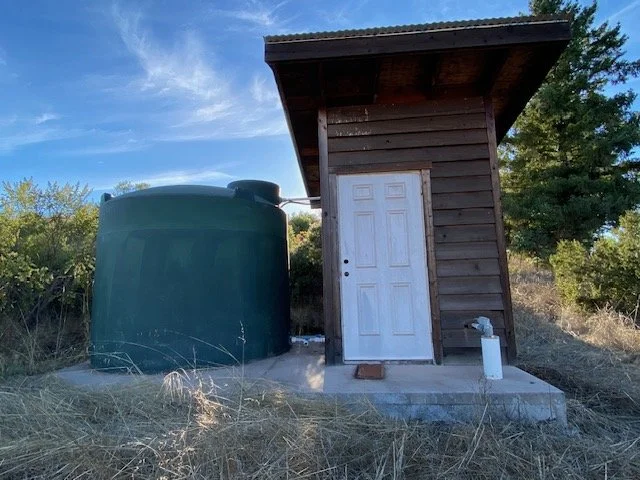
A water well, pump house and storage tank.
One of the most important questions people have when buying property in Anderson Valley is about the water situation. What is the water source? How much water does it produce? What is the water like, particularly in terms of quality?
Most properties in Anderson Valley are serviced by wells, though some get water from springs. We do not have a municipal water source; there is a private water system in the Estate Drive section of Boonville, and even there many of those properties have wells in addition to the private water service.
Where does our water come from?
Well, that depends. In some parts of the Valley, particularly along the ridgetops, groundwater moves through fractures in the bedrock. In other areas, particularly on the Valley floor, groundwater is found in the spaces between sand, gravel, and other sediments. Our rainfall also impacts how much water we have, particularly for springs.
How deep are most wells?
They vary - sometimes you don’t have to drill very far and you hit water, and sometimes you have to go 300’ or more to find water. In my experience, 300’ is a deep well for our area. I know there are other parts of the country where they go much deeper for water. And you can find one person with a shallow well and their neighbor with a deep one - it just depends on where they hit water. The depth of a well doesn’t necessarily tell you how much water it will produce.
There is one true thing about wells - what the well produces today is no guarantee of what it will produce tomorrow. And even the quality can change - as a child we had a really good producing well; then there was an earthquake in Willits and suddenly our water developed a strong sulfur odor and we had to abandon the well for everything except irrigation.
How are most wells drilled?
Today, most wells are drilled by a large drilling rig operated by a company specializing in drilling wells. Before this this equipment was readily available a lot of wells were dug by hand - I still sell properties with hand-dug wells, though many of these wells have since been replaced by a newer well. How do you decide where to drill? This depends - often you are limited by where the drilling company can get the rig - just because you think there is water up or down a hillside doesn’t mean you will be able to drill there. The rig is a large piece of equipment and it’s mobility is limited. Some folks rely on a water witch to find water - my own family had a good friend who witched both of our wells and she was spot-on about the depth and the productivity of the wells. Science doesn’t back the use of water witches, but at least locally many people have used them successfully. There are also newer technologies being developed and used to help identify promising locations for drilling wells by examining geological conditions beneath the surface.
What about production?
What is a “good producer?” Wells are measured in gallons per minute (GPM); generally, in my experience a good well is going to be around 10 GPM or more, an average one four to five GPM, a low producer under that. However, unless you are going to be doing something that is really water dependent (agriculture for example), even a well producing one gallon per minute is going to produce 1,440 gallons per day; according to the EPA the average American uses approximately 82 gallons of water per person per day at home. Depending on family size, that 1,440 gallons can go a long way. Of course, that assumes the well can sustain one gallon per minute around the clock, and that the pump and water system are designed to operate accordingly. Which brings us to water storage, which provides a way to use the water immediately without straining the well. Keep in mind that during years of drought that one gallon could be less, so most people want more GPM, which is understandable.
How is the amount of water production measured?
Usually, when a property is being purchased the buyer (and sometimes the seller) will hire someone to come do a well production test. This is typically a four-hour test. The water is pumped out of the well and the flow rate is measured periodically. There is a usually a high number at the outset of the test and then a lower but usually sustained number by the end of the test - that ending number is often used to describe the well’s production rate. The test may also will measure the depth from the top of the well to the water before and during pumping and measure the well’s recovery rate after pumping stops. While this test provides good information for that day, it’s best to remember that on a different day, at a different time of year or during a drought, that number may be different.
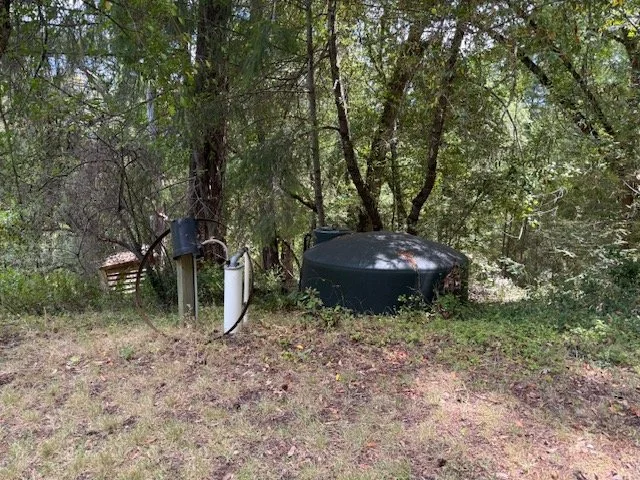
Water well and storage tank
How is the water brought from the well to the house or other improvements?
Usually there is a submersible pump in the well that runs either off of PG&E electricity or solar panels. the amount of water pumped depends on the pump, available power, and the design of the system; some solar-powered systems may have lower pumping capacity. The water is then plumbed to the various locations, such as to the house or to a storage tank or tanks. Water can also be plumbed to faucets for irrigation either directly or from the tanks. Once at the house, people often have a second pump, called a pressure pump, with its own pressure tank, so that the water coming out of faucets is strong enough. Occasionally I will see a property with enough gravity feed from a tank to the house that a pressure pump and tank aren’t required. This is also nice if the power goes out - you will at least have gravity fed water to the house.
What about water quality?
Water in Anderson Valley varies a lot; some water is high in mineral content, some is high in contaminants that make it unsafe to drink without treatment, and some water is contains contaminants at levels that make treatment impractical or prohibitively expensive. My own water, which comes from a spring, is very high in calcium, so I get crusty buildup around all of my faucets. However, it’s fine to drink. I’ve seen wells with manganese that needed to be treated before the water could be used for drinking, with boron so high it wasn’t treatable and once a well with arsenic in it that fortunately was treatable. Water that looks clear and tastes good isn't necessarily safe to drink. Testing can reveal contaminants such as bacteria, nitrates, and naturally occurring arsenic that may not be noticeable by taste or smell. For this reason, water quality testing is just as important as testing production.
Overall, when you are planning to buy a piece of land in Anderson Valley it is a good idea to ask about the water situation. You should have the water tested for both quantity and quality. You need to know what you are buying and know what adjustments you need to make. A reliable water supply is one of the most important features of any rural property, and understanding that supply before you buy can save you considerable expense and frustration later.